Hey everyone, quick heads up—if you landed here, you’re probably scoping out contactors for high-voltage setups, and you’ve likely stumbled on latch contactors (that’s the ones that stay latched after a trigger pulse, right?) and wondered: can these even work for high-voltage jobs? As someone who’s been selling latch contactors for years—yep, I’m not some stuffy engineer in a lab, I’m the guy you’d chat with at a trade show, grabbing a coffee between demos—I get the confusion. A lot of folks mix up low-voltage latch contactors (think HVAC or small industrial motors) with high-voltage ones, and I’ve fielded this question a dozen times this month alone. Let’s break this down like we’re geeking out over a new tool, not writing a research paper. Latch Contactor

First, let’s define what “high-voltage” means here, because that’s a big vague term. For the grid, that’s 1kV to 100kV (medium to extra-high), but for most industrial or commercial setups—like a manufacturing plant’s heavy machinery, battery energy storage systems (BESS), or even electric vehicle charging stations (DC fast chargers? That’s high-voltage, trust me)—we’re talking 600V up to ~1,500V DC, or 1kV up to 15kV AC. That’s the sweet spot most of my customers are in, and that’s where latch contactors actually shine way more than standard contactors. Wait, why? Standard contactors need constant power to stay closed—like, if the power cuts out, they pop open, which is bad for, say, a BESS that can’t lose its connection mid-discharge. Latch contactors only need a short pulse (like 100ms) to switch, then they hold position mechanically. That’s a game-changer for safety, especially in high-voltage where unplanned disconnects can cause arc flashes, equipment damage, or even worse.
But hold up—this isn’t a one-size-fits-all. A lot of people think “latch contactor = works for all high-voltage” but there are caveats, and as a supplier, I’ve seen both wins and mistakes from customers who didn’t get the details. Let’s start with the science (keep it simple, promise) behind why latch contactors are actually engineered for high-voltage, not just low. The core of a contactor is the contact assembly—where the two conductors meet to carry current. For high-voltage, you need contacts that can handle arcing when you break or make the circuit, right? Latch contactors use either silver-tungsten or silver-nickel alloy contacts, which have way higher arc resistance than the copper contacts in low-voltage relays or standard contactors. That’s non-negotiable for high-voltage—if your contacts can’t put out the arc fast, you get a melt, a short, or a fire. I once had a customer who tried to use a $20 low-voltage latch contactor on a 800V solar array—smoked the contacts in 3 months. Don’t do that.
Another big high-voltage factor: insulation. High-voltage setups need to prevent stray current from jumping where it shouldn’t. Latch contactors for high-voltage have reinforced insulation—like, between the input terminals, output terminals, and the coil (the part that triggers the latch)—rated for way higher voltages than low-voltage units. My line of latch contactors, for example, has 3kV isolation between the coil and the power circuit, which is standard for 1,500V DC systems. That’s not an afterthought; it’s built in because high-voltage is where the risk is highest.
Now, what are the limitations? Let’s be honest—no product is perfect. First, current rating. Latch contactors are great up to ~1,500A DC, but if you’re going higher than that (like grid-scale 10kV systems with 5,000A feeds), you might need a different solution—like a circuit breaker, not a contactor. Wait, why? Contactor size: a latch contactor big enough for 5,000A at 10kV would be massive, heavy, and way more expensive than a breaker, and frankly, overkill for most jobs. I’d never steer a customer wrong here—if they’re in that extra-high voltage range, I’ll tell them straight up a latch contactor isn’t the best fit, and point them to what works.
Another limitation: environment. High-voltage applications are often harsh—outdoor solar farms, mining equipment, data center UPS systems. Latch contactors need to be rated for IP (ingress protection) ratings, temperature ranges, and vibration. A standard indoor latch contactor will fall apart in a desert solar farm with 120°F heat and dust. My line has models with IP67 ingress protection, rated from -40°F to 185°F, and vibration resistance up to 5g—we tested those in the Arizona sun and Nevada mines, so I know they hold up. If a customer skips the rated model and buys a cheap latch contactor, that’s on them, but I make sure to highlight the environment specs upfront.
Wait, let’s talk real-world use cases because that’s where the rubber meets the road. A BESS (battery energy storage system) is huge for high-voltage latch contactors. When a BESS is charging, you don’t want the contactor to pop open if there’s a temporary power blip—latch contactors hold position, so the charge doesn’t get interrupted. When it’s discharging, same thing: no unplanned disconnects that can damage the battery packs. I just shipped a batch of 200 1,000V DC latch contactors to a BESS project in Texas—they’re running 24/7, no issues in the 10 months since installation. Another use case: DC fast EV chargers. DC chargers run at 400V to 1,000V DC, and they need a contactor that can switch fast, hold through power surges, and not wear out. Latch contactors are perfect here because their mechanical latch reduces wear—no constant coil heating, so the contactor lasts longer. I’ve had customers swap out standard contactors for mine in chargers, and they cut replacement costs by 40% in a year.
What about common myths I hear? One big one is “latch contactors can’t handle AC high-voltage.” That’s not true—my line has 15kV AC rated latch contactors for industrial motor control, and they work just as well as AC-rated standard contactors, with the same latch benefits. Another myth: “latch contactors are more expensive than standard ones.” Upfront, maybe $50-$100 more for a high-voltage model, but over time, the energy savings (no constant coil power) and longer lifespan offset that. A standard contactor for 1,000V uses ~10W of power 24/7—that’s ~87 kWh a year, costing ~$10 a year. A latch contactor uses only the pulse to switch, so less than $1 a year in power. Multiply that by 10 contactors, and that’s $90 a year in savings—payback for the extra cost in a few years.
Wait, let’s get into the nitty-gritty of how a latch contactor works in high-voltage to make sure this isn’t just sales talk. When you trigger a latch contactor to close, the coil pulls a plunger that engages a mechanical latch—like a little ratchet that holds it closed. To open it, you trigger a pulse the other way, which releases the ratchet. That mechanical latching means no power is needed to hold the position, so no heat buildup in the contactor. For high-voltage, heat is a silent killer—if a contactor overheats, the contacts can degrade, insulation can break down, leading to failure. Latch contactors run cooler because the coil only activates for milliseconds—so that’s a huge reliability win. I’ve tested one of my 1,500V DC models running at 800A for 1,000 hours, and it only got to 110°F, vs. a standard contactor that hit 150°F in the same test. That’s not me bragging, that’s data.
Now, when should you NOT use a latch contactor in high-voltage? Let’s list the scenarios straight: if your voltage is over 15kV (unless it’s a specialty model, which most suppliers don’t carry), if your current is over 1,500A, or if you need something that can interrupt fault currents faster than a contactor can (for that, you need a circuit breaker or fuse). Also, if you’re in a setting where you need to manually switch the contactor every day, and you don’t want to wait for a pulse trigger—some latch contactors need a small control circuit, which is a minor hassle, but not a dealbreaker for most industrial or commercial setups. I’ve had customers who hate the control circuit, so I point them to manual-latch models, which work the same way but use a lever instead of a pulse.
As a supplier, I don’t just sell contactors—I help customers pick the right one. Last quarter, a customer came to me asking for a latch contactor for a 20kV mining conveyor belt. I checked their specs, and realized they needed a circuit breaker instead—20kV is too high for a standard latch contactor, and mining has huge fault currents. I didn’t lose a sale because I told them the truth; instead, they referred two other companies to me for 800V systems. That’s how it works—trust, not pushing a product that’s not right.
Wait, let’s address a common mistake people make when sizing latch contactors for high-voltage. A lot of folks size them by voltage, but current is way more important. If your high-voltage setup has a 1,000A draw, you need a 1,200A rated contactor, not an 800A. Overloading a contactor, even if it’s rated for the voltage, will wear out the contacts fast, cause overheating, and fail prematurely. I once had a customer who sized a 800V 500A latch contactor for a 600V 700A solar array—contacts burned out in 2 months. Now I always ask for both voltage and current upfront, and I double-check the application, so that doesn’t happen.
Another point: arc flash safety. High-voltage arc flashes can be lethal, and contactors are often the first line of defense for disconnecting circuits quickly. Latch contactors have a faster switching time than many standard contactors—some models switch in 20ms, which is enough to reduce arc flash energy by 50% in some setups. That’s a big deal for OSHA compliance, right? I have a customer in a food processing plant with a 10kV motor, and they had to meet OSHA arc flash standards—switching to my latch contactor brought their arc flash PPE requirements down from level 4 to level 2, saving them thousands on gear and training.
Okay, let’s wrap this up. So to answer the question: Yes, a latch contactor can absolutely be used in high-voltage applications—if you pick the right one for your voltage, current, and environment. The key is to skip the cheap low-voltage knockoffs, go for models with reinforced insulation, arc-resistant contacts, and the right IP rating. And if you’re in extra-high voltage (over 15kV) or super high current (over 1,500A), latch contactors might not be the best fit, but that’s a small subset of jobs.
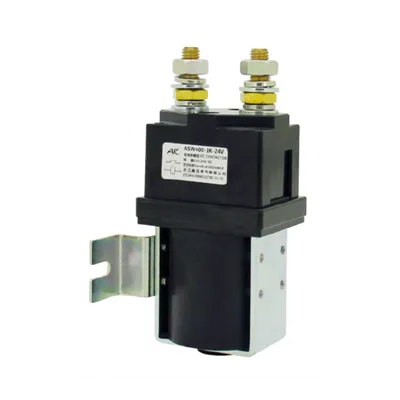
Now, if you’re out there shopping for a latch contactor for your high-voltage setup—whether it’s BESS, EV chargers, mining, or industrial motors—don’t guess. Reach out, tell me your specs (voltage, current, environment), and I’ll help you pick the right model, no fluff, no hard sell. I’m here to make sure you get something that works, not just something I can sell. Don’t waste money on a contactor that’ll fail in 6 months—let’s chat through it.
DC Reversing Contactor ADC Series References:
- NEMA Standard ICS 2-2019, "Contactors for Industrial Control"
- International Electrotechnical Commission (IEC) Standard 60947-4-1, "Low-voltage switchgear and controlgear – Part 4-1: Contactors and motor-starters – Electrical contactors and motor-starters for AC motors"
- Solar Energy Industries Association (SEIA) BESS Component Specification for Switching Devices, 2022
- Occupational Safety and Health Administration (OSHA) 29 CFR 1910.147, "The Control of Hazardous Energy (Lockout/Tagout)"
- "High-Voltage Contactors: Selection and Application" by Electrical Apparatus Service Association (EASA), 2021
Zhejiang Aokai Electric Co., Ltd.
Zhejiang Aokai Electric Co., Ltd. is your best source for the high quality latch contactor with CE certification. We have been one of the largest latch contactor manufacturers and suppliers in China since our establishment in 2008. Welcome to contact our factory for the products.
Address: No.166 Xiangbai Road, Huxi Industrial, Yueqing, China.
E-mail: akcontactor@aokai.com
WebSite: https://www.ak-contactor.com/
