If you’ve ever spent time shopping for automotive lights, you’ve probably stumbled across the P28S bulb code and paused—because there’s a lot of confusion floating around about whether it’s single or double contact. As someone who’s been supplying P28S bulbs for years, I get questions about this almost every single day from mechanics, car owners, and even other lighting retailers. Let’s break this down straight, no jargon, no fluff. P28S Bulb
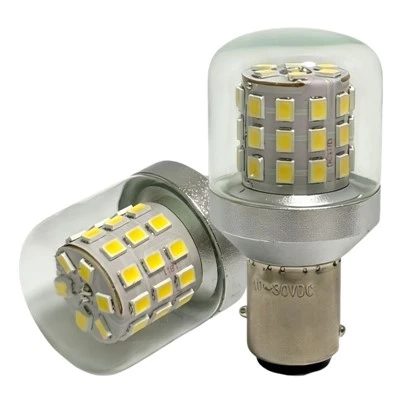
First, let’s start with the basics: what does that “P28S” even mean? The “P” here stands for “prefocus base”—that’s the standard bulb base design where the filament sits centered, aligned perfectly with the reflector in automotive headlights or turn signals. The “28” refers to the diameter of the base in millimeters, and the “S” is for “screw-in” style. That part’s pretty consistent across all SAE and ECE (the two main global lighting standards) definitions.
Now, the big question: single or double contact? Here’s where it gets a little tricky because people mix up the base type with the contact points. A single-contact bulb has one electrical pin (or tab) to send power to the filament, and a metal shield on the base that acts as the ground return. A double-contact bulb has two separate pins (or tabs), so you can power two different filaments without a ground loop—super common for dual-function lights like a brake/turn signal that also acts as a running light.
For P28S specifically, the standard design is single contact. Wait, let me confirm that—SAE J599, which is the US standard for automotive lighting, explicitly lists the P28S as a single-contact prefocus base. That means only one electrical contact point for power, plus the base itself serves as the ground. But here’s why people get confused: there are variants of P28S out there that look similar but have two contacts. Those are often mislabeled as P28S, but they’re actually a different type—usually P28D, where the “D” stands for double contact. I’ve seen this happen a lot with cheaper no-name bulbs, especially on third-party marketplaces, where sellers cut corners and mislabel base types. That’s the root of most of the confusion.
Let me give you an example to make it real. Last month, a regular customer came to me because he’d bought a set of “P28S” turn signals for his 2018 Honda Civic, and they wouldn’t work right. The problem? The bulbs he’d ordered had two contact tabs, but his car’s socket only had one power pin. The bulb was trying to draw power from both tabs, creating a short circuit. Once we sorted that out, he got the correct single-contact P28S bulbs, and it worked perfectly. That’s the kind of mix-up that happens when you don’t know the difference between the actual standard and the mislabeled stuff.
Another thing to note: single-contact vs. double-contact isn’t just a random detail—it affects what the bulb can do. A single-contact P28S is almost always used for single-function lights: a marker light, a fog light, or a turn signal (if it’s not a dual-function). Double-contact bulbs, by contrast, are for when you need two filaments in one bulb. For example, a common dual-function bulb is one that does running light (low brightness) and brake light (high brightness)—that needs two separate power feeds, so you need a double-contact base. If you try to put a single-contact bulb into a dual-function socket, you can only get one function to work; if you put a double-contact into a single-contact socket, you might get a dim or erratic glow because the ground isn’t set up right.
Now, let’s talk about how to tell them apart if you’re holding a bulb in your hand. For P28S (single contact), look at the bottom of the base: there’s one small metal tab sticking out from the side, and the rest of the metal base is smooth and continuous—no other tabs. For the mislabeled double-contact versions that sometimes get called P28S, you’ll see two separate, identical tabs on opposite sides of the base. That’s a quick visual check anyone can do, no tools needed.
I should also mention that some people use “P28S” as a catch-all term for any prefocus 28mm screw-in bulb, but that’s not accurate. The ECE standard (which is used in Europe, Asia, and most other parts of the world) is just as clear as SAE: P28S is single contact, P28D is double. The confusion comes from the fact that a lot of suppliers (not just us, to be fair) will occasionally shorthand labels, but when you’re dealing with a bulb that’s critical for your car’s safety—like a headlight or brake light—you can’t rely on shorthand.
From a supplier’s perspective, we make it a point to be transparent with our customers. Every single P28S bulb we sell is clearly labeled as single contact, with a photo of the base so you can check the tabs. We even include a note in our product descriptions about the difference between P28S and P28D, because we’ve seen too many headaches from misordered bulbs. Last quarter, we had a bulk order from a small auto repair shop that came back because they’d bought mislabeled bulbs, so we updated our product pages to flag that difference right at the top. That’s the kind of thing that matters when you’re supplying parts people rely on.
Wait, let’s address a common myth I hear: some people say P28S can be either, depending on the car. Nope, that’s not how it works. The socket in your car is designed for either single or double contact. If your car’s socket has only one power pin, you need a single-contact bulb. If it has two power pins, you need double. The base type (P28S vs. whatever) just tells you the size and shape, but the contact count is a separate spec. So even if two bulbs are both P28S, if one’s mislabeled double contact, it won’t fit your socket right.
Another example: a customer who works on vintage Volvos came to me last year. His 1972 Volvo 142 uses P28S bulbs for the front parking lights. He’d tried a set of “P28S” bulbs from a big-box store, and they were too short and had two contacts, so they wouldn’t seat right in the old socket. Our single-contact P28S bulbs fit perfectly, and he said they lasted twice as long as the cheap ones he’d bought before. That’s the value of getting the right spec from a supplier who knows what they’re talking about.
So to wrap this up, the short answer is: a true P28S bulb (as per global automotive lighting standards) is single contact. The confusion comes from mislabeled products that are actually double-contact bulbs being incorrectly called P28S. To avoid problems, always check the number of tabs on the base before ordering, and work with a supplier that’s clear about their bulb specs.

If you’re in the market for P28S bulbs—whether you’re a mechanic fixing a customer’s car, a car owner replacing a burnt-out light, or another retailer restocking your shelves—don’t guess. Reach out to us. We can help you confirm which bulb you need, answer any other questions you have about contact points, base types, or longevity, and make sure you get the right part the first time. No more returns, no more erratic lights—just straight, accurate info and quality P28S bulbs.
T25 Bulb References
- Society of Automotive Engineers (SAE) Standard J599: Light Sources and Lamps for Road Vehicles, 2022
- United Nations Economic Commission for Europe (ECE) Regulation No. 87: Front Position Lamps for Power-Driven Vehicles, 2021
- Automotive Lighting Industry Association (ALIA) Technical Bulletin: Prefocus Base Designations, 2020
Nicebulbs
As one of the most professional p28s bulb manufacturers and suppliers in China, our products have good reputation in the market. Please feel free to wholesale cheap p28s bulb for sale here and get pricelist from our factory. Quality products and reasonable price are available.
Address: No. 86 Zhongli Road, Nancheng Street, Dongguan City, Guangdong Province
E-mail: vic@nicebulb.com
WebSite: https://www.nicebulbs.com/
